In 2001, when the 3rd edition of “The Hurried Child” was published, the author Dr.David Elkind had this to say ………
“The bewildering rapidity and profound extent of ongoing social change are the unique hallmarks of our era, setting us apart from every previous society. For us, in the foreseeable future, nothing is permanent.”
So what changes were folks in 2001 dealing with? Here are some –
- The beginnings of India’s IT middle class with emerging software services, BPOs etc. The emergence of new job titles. Example – software engineer.
- So a shift from government & PSU jobs to working in the private sector
- The start of night shifts and the end of normal sleep & rest cycles
- The dot com crash of 2000 resulted in job security anxiety issues
- Performance appraisals started about now
- Conference calls, foreign clients, and work cultures we had never been exposed to
- Continuous learning starts to gain importance
- While rural India had always moved to the cities for jobs, this migration increased manyfold now
- Less extended family support when people migrated to the cities for jobs
- Parents worried their children would fall behind in the race if they did not learn how to use computers and the triad of software – Excel, Word & Power point. This has been replaced by AI in 2026
- The concept of buying anything on EMIs started picking up – white goods, 2 wheelers, houses (apartments) and much more
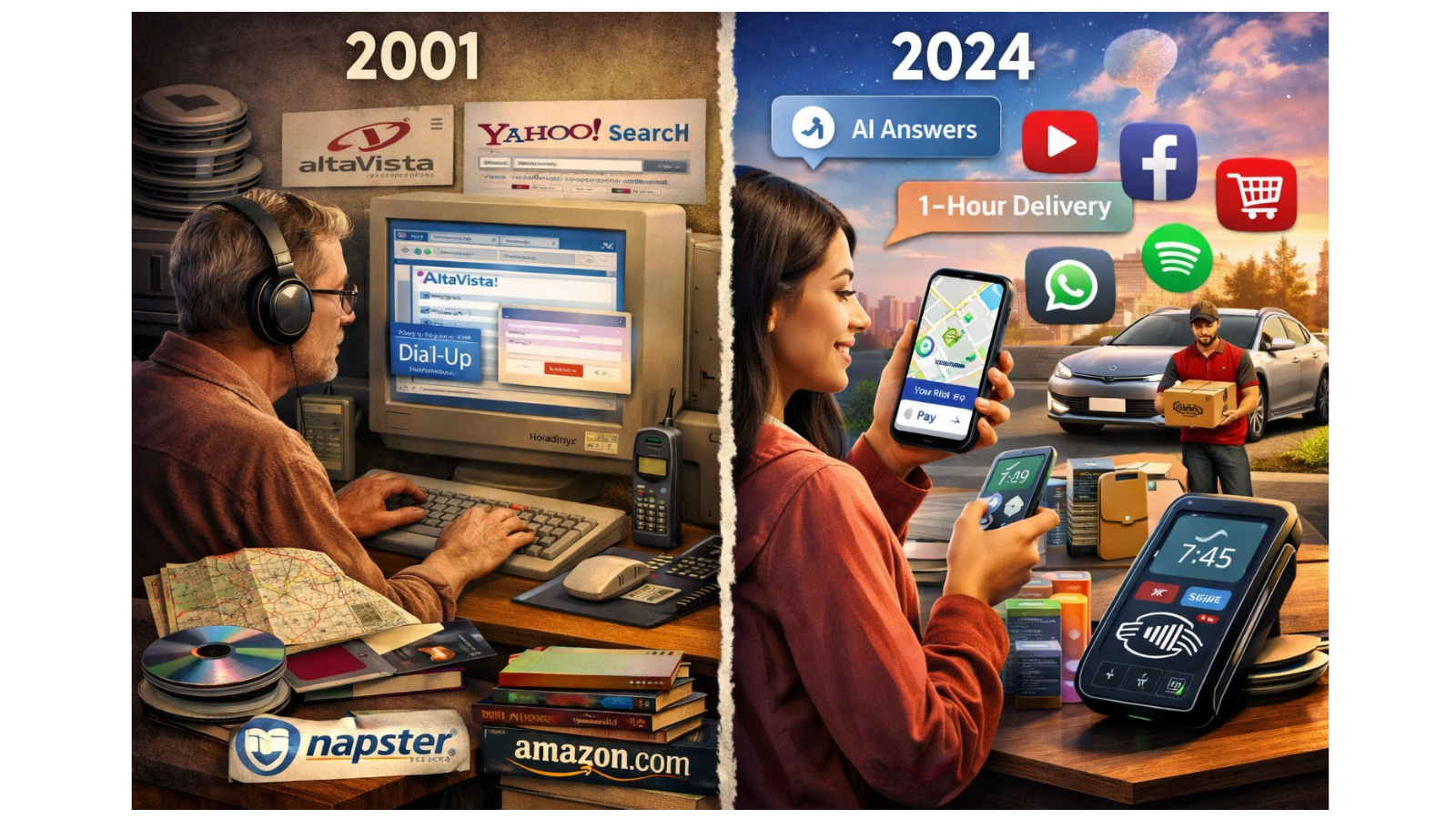
Now let’s look at some standout changes between 2001 and 2026, shall we?
- Smartphones as we know them today did not exist in 2001. Nokia & Blackberry were the leading handset manufacturers and mobiles were used for making calls or texting
- Mobile apps that we take for granted (Uber/Ola/Zomato etc.) did not exist in 2001
- 2001 – Amazon existed as an online bookstore with limited categories of books
- 2001 – Desktop based early stages of e-commerce with long delivery times
- No streaming video/music – Netflix was a DVD by mail service only in the USA
- Social media – did not exist
- There was no generative AI, no large language models, and no real-time consumer AI
- Payment was primarily with cash. Cheques & Demand Drafts were the primary non-cash methods of payment. No IMPS/NEFT etc. Not many people had credit cards. Debit cards were used primarily to withdraw cash from ATMs. So everything we take for granted today – UPI, wallets, QR codes, payment apps – nothing existed in 2001.
- Laptops were costly and desktops (branded and unbranded) were more common – in offices & at home
- Broadband as we know it today was rare & expensive – dial up connectivity using landlines was the way people connected to the internet.
- Sure search engines like Google & Yahoo were there but one had to type multiple word combinations to get results
The list can be much longer but i guess the above points give us a very clear picture of the changes in the last 25 years. In fact in 2026, we accept that some technology is obsolete in a few months or at best a year.
Our reaction to rapid change and impermanence is stress – this has not changed in the last 25 years, unfortunately.
Stressed folks are obviously absorbed with themselves & the problems they are coping with and they don’t have the bandwidth to look at the problems and needs of others. This brings me to how stressed people deal with having children and raising children.
Traditional extended supportive cultures like those in China, Japan and even India meant that parents were freed to some extent of the stress of adapting to change and were able to devote “quality time” to their growing children and the children’s needs.
This started changing after the economic liberalization of 1991 and by 2001 parents were finding it difficult to devote the time & energy to know their child and allow the child to grow at her own natural pace. These stressed parents quite often had a symbol or a benchmark (like a famous sportsperson) they wanted their child to emulate. An example – the Williams sisters of the tennis world who started playing the game at a very young age.
These symbols or benchmarks may also be coming from unfulfilled needs from their own growth years. Symbols according to David Elkind are an easy way out for the stressed parent/s but in reality they are hurrying the child through the normal stages of growing into an adult and this pressure ultimately harms the child.
In Part 2 of this article, i will explain in detail the various angles (or dynamics) which stressed parents knowingly or unknowingly start applying in their relationships with their children, all of which are counterproductive to the natural growth of the child.
To be continued —–